Ten years, one face
Studio Woudt B.V.
October 30, 2026
|
March 31, 2027


It began in 2015 with a mood board. Woudt showed it to Mushore, and she recognised something of herself in it. From that moment, a conversation started that has never stopped. The collaboration has produced a large part of Woudt's best-knownimages, work now held in the collections of the Getty Museum in Los Angeles, the Rijksmuseum and Museum Kranenburgh, and sold at Christie's, Sotheby's and Phillips.
Mushore is a muse in the oldest sense of the word, and a great deal more than that. She grew up in Zimbabwe, where she stood in front of the camera as a child following her mother, and moved to the Netherlands at twelve. In an interview for 1605 Collective, she spoke openly about what it means to work as a Black model in the Dutch industry: about being selected for diversity, aboutmake-up artists who are not prepared for her skin, about the narrow image the industry holds of Black women. That conversation has become part of the work. In the studio it was never only about form and light.
Their sessions unfold with few words. The images grow from an understanding that has deepened over the years. Their first publication together, the book Tino (2020), sold out in five days. In December 2025, the ten-year collaboration formed the heart ofWoudt's presentation at Masters Expo in Amsterdam, where he rebuilt part of his Alkmaar gallery inside the RAI and showed new work with Mushore.BASTIAAN WOUDT: “I am incredibly proud and grateful that in a career of fifteen years I have found someone with such a large impact on my work. Beyond being a wonderful person, she is one of the best collaborators a photographer could wish for. We have a very strong connection. We always think of each other, and we make the images most people picture when they think of my work.”TINOTENDA MUSHORE: “Thank you for seeing me for me, and not the version of me you would like me to be. Working with you has made me love myself more. It’s been an absolute honour to have you capture me these past 10 years, and I cannot wait to see what the next 10 years will bring.”
What hangs on the walls is unmistakably Woudt: monochrome, graphic, reduced to light, shadow and form. Strong contrasts, precise compositions, an almost sculptural treatment of the human body. The choice for black and white is not an aesthetic convenience but a reduction: everything that distracts is removed.
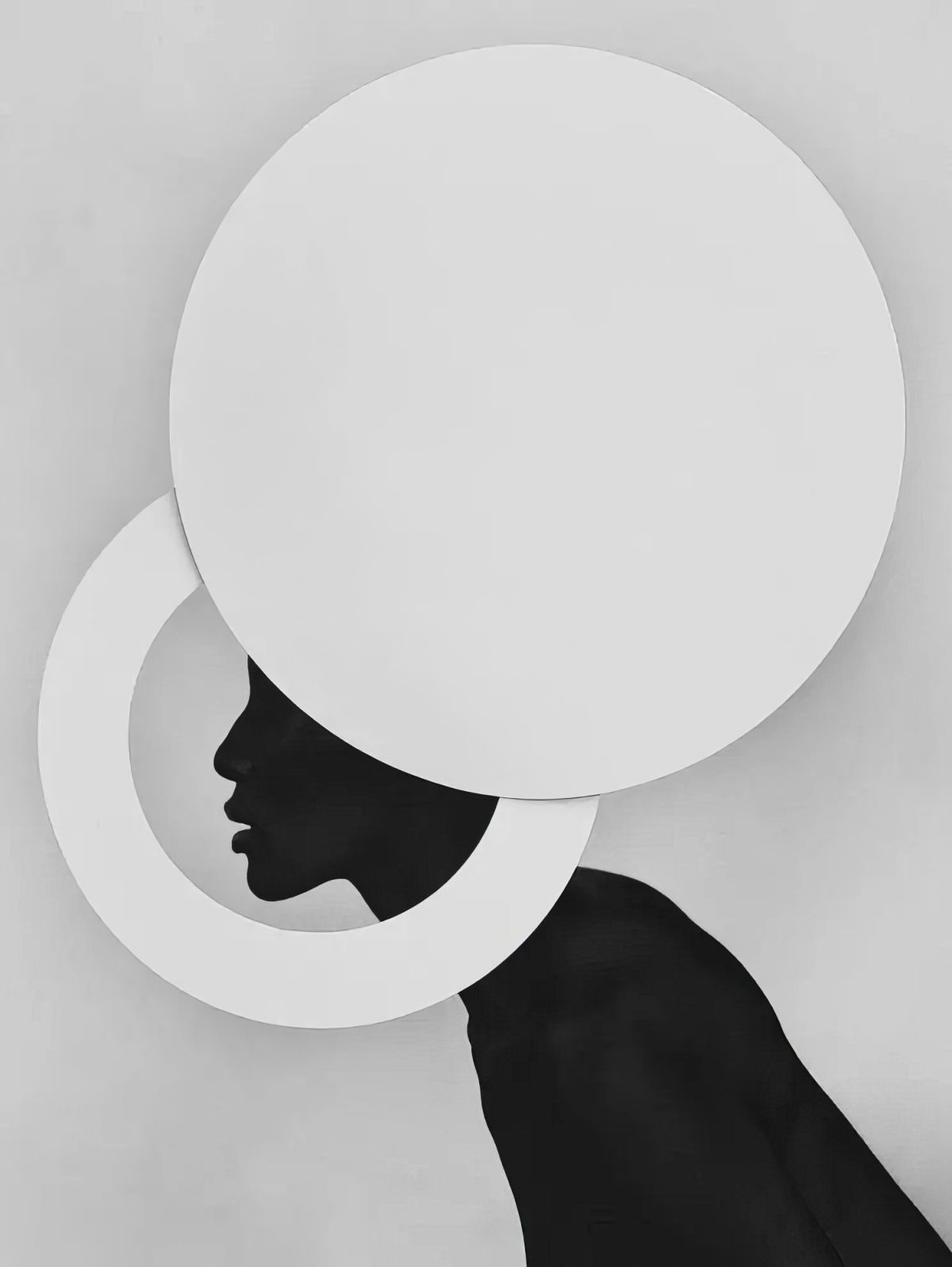
Yet the series as a whole shows something a single photograph cannot. In the earliest works you see skin, hair and grain, and barely an object. Gradually the form takes over. In Cycle II (2020) the face is still a silhouette between two white discs, and in Fold(2022) the body all but disappears beneath a pleated fan. In the most recent work, it returns to fabric, gesture and presence. Returning to the same frame for ten years does not produce repetition, but a shift, and that shift is only visible when everything hangs side by side.
The fifteen works are shown in four formats, all in limited edition. Among them are Tino Crown (2016), Swirl, Athena, Fold and Modiste, the most recent work in the series.
The collaboration continues. In March 2026 Woudt and Mushore worked together on set for Maison Michel, the Parisian millineryhouse that has been part of Chanel since 1997. That day produced Modiste, the most recent work in the exhibition: a wide black straw hat, her profile beneath it, the body wrapped in a dark cone. The title is the French word for milliner. That headwear is treated as sculpture; there is no coincidence, since it has been a recurring motif in their work from the beginning.