© Virginia McGee Richards | The Inner Passage


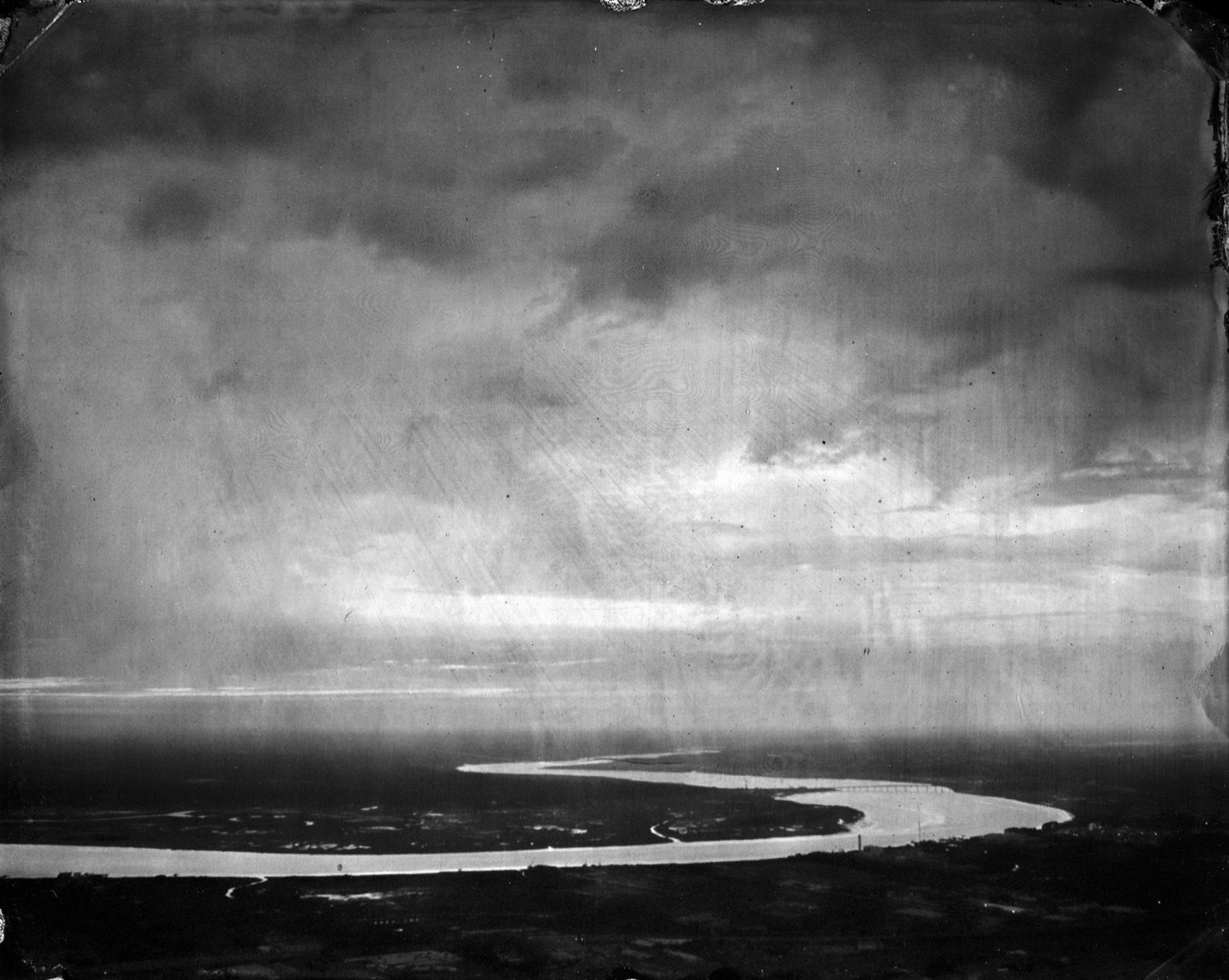
Her series, The Inner Passage, explores colonial-era canals built by enslaved Africans, whose forced labour transformed the landscape and whose names have been forgotten. Using archival research and fieldwork, Richards reconnects these routes to stories of resilience and self-emancipation. She employs wet-plate collodion photography, capturing the changing tidal terrain where natural elements leave their mark. Her portraits of marshlands, ancient trees, and descendants with deep roots in this land serve as a profound reflection on memory, heritage, and the persistent influence of place.


Virginia McGee Richards: The Inner Passage began with a question. While cooling off in a river near my home in Charleston, South Carolina, I found myself thinking about the deep histories held in the landscape and surrounding waterways. That moment sparked a fifteen-year inquiry—part fieldwork, part archival excavation—into the maps, documents and lived memories embedded in the region’s marshlands.


My research uncovered a largely unrecorded network of colonial-era canals carved along the Atlantic coastline from Charleston, South Carolina, to St. Augustine, Florida. Built by enslaved Africans using little more than shovels and axes to clear forests and excavate coastal mud, these waterways remain sparsely documented. The names of the Black labourers were never recorded. Enslaved people also used the Inner Passage to self-emancipate, navigating from South Carolina and Georgia to Spanish Florida, where they were granted freedom. This layered history shaped my approach to the work.

I turned to wet-plate collodion, a nineteenth-century photographic process whose alchemical unpredictability mirrors the watery, shifting world I sought to capture. A slight change in temperature or humidity alters the chemistry and the final image on the glass.
This immersion gave rise to portraits of trees, landscapes, and living descendants linked to the waterways. All the individuals I photographed have family histories deeply rooted in the region for centuries, embodying the geological and cultural history embedded in the land.
All the individuals I photographed have family histories deeply rooted in the region for centuries, embodying the geological and cultural history embedded in the land.
About
.svg)


.svg)
.svg)

Her series, The Inner Passage, explores colonial-era canals built by enslaved Africans, whose forced labour transformed the landscape and whose names have been forgotten. Using archival research and fieldwork, Richards reconnects these routes to stories of resilience and self-emancipation. She employs wet-plate collodion photography, capturing the changing tidal terrain where natural elements leave their mark. Her portraits of marshlands, ancient trees, and descendants with deep roots in this land serve as a profound reflection on memory, heritage, and the persistent influence of place.
Virginia McGee Richards: The Inner Passage began with a question. While cooling off in a river near my home in Charleston, South Carolina, I found myself thinking about the deep histories held in the landscape and surrounding waterways. That moment sparked a fifteen-year inquiry—part fieldwork, part archival excavation—into the maps, documents and lived memories embedded in the region’s marshlands.
My research uncovered a largely unrecorded network of colonial-era canals carved along the Atlantic coastline from Charleston, South Carolina, to St. Augustine, Florida. Built by enslaved Africans using little more than shovels and axes to clear forests and excavate coastal mud, these waterways remain sparsely documented. The names of the Black labourers were never recorded. Enslaved people also used the Inner Passage to self-emancipate, navigating from South Carolina and Georgia to Spanish Florida, where they were granted freedom. This layered history shaped my approach to the work.
I turned to wet-plate collodion, a nineteenth-century photographic process whose alchemical unpredictability mirrors the watery, shifting world I sought to capture. A slight change in temperature or humidity alters the chemistry and the final image on the glass.
This immersion gave rise to portraits of trees, landscapes, and living descendants linked to the waterways. All the individuals I photographed have family histories deeply rooted in the region for centuries, embodying the geological and cultural history embedded in the land.
All the individuals I photographed have family histories deeply rooted in the region for centuries, embodying the geological and cultural history embedded in the land.
About
Her series, The Inner Passage, explores colonial-era canals built by enslaved Africans, whose forced labour transformed the landscape and whose names have been forgotten. Using archival research and fieldwork, Richards reconnects these routes to stories of resilience and self-emancipation. She employs wet-plate collodion photography, capturing the changing tidal terrain where natural elements leave their mark. Her portraits of marshlands, ancient trees, and descendants with deep roots in this land serve as a profound reflection on memory, heritage, and the persistent influence of place.
Virginia McGee Richards: The Inner Passage began with a question. While cooling off in a river near my home in Charleston, South Carolina, I found myself thinking about the deep histories held in the landscape and surrounding waterways. That moment sparked a fifteen-year inquiry—part fieldwork, part archival excavation—into the maps, documents and lived memories embedded in the region’s marshlands.
My research uncovered a largely unrecorded network of colonial-era canals carved along the Atlantic coastline from Charleston, South Carolina, to St. Augustine, Florida. Built by enslaved Africans using little more than shovels and axes to clear forests and excavate coastal mud, these waterways remain sparsely documented. The names of the Black labourers were never recorded. Enslaved people also used the Inner Passage to self-emancipate, navigating from South Carolina and Georgia to Spanish Florida, where they were granted freedom. This layered history shaped my approach to the work.
I turned to wet-plate collodion, a nineteenth-century photographic process whose alchemical unpredictability mirrors the watery, shifting world I sought to capture. A slight change in temperature or humidity alters the chemistry and the final image on the glass.
This immersion gave rise to portraits of trees, landscapes, and living descendants linked to the waterways. All the individuals I photographed have family histories deeply rooted in the region for centuries, embodying the geological and cultural history embedded in the land.
All the individuals I photographed have family histories deeply rooted in the region for centuries, embodying the geological and cultural history embedded in the land.
About